
It is commendable that so many people are interested in learning how to play a game whose pieces feature writing in a language they likely don't understand. But one doesn't need to master Mandarin to learn how to play Chinese Mahjong. They only need to know what the tile symbols represent, what constitutes a winning hand, and the strategies that lead to a win. These aspects and more are what this article covers.
Mahjong for Beginners: What to Know
- Mahjong is a draw-and-discard type of game, played with tiles instead of cards.
- The standard Chinese mahjong set comprises 144 tiles, divided into seven groups.
- There exist many versions of this game, but there is no universal rulebook to define them all.
- Winning at mahjong depends as much on luck as on strategy and skill.


What Is Mahjong?
Mahjong (麻将 - májiàng) is a type of draw-and-discard game modelled on older Chinese card games. Its name comes from máquè (麻雀), the Chinese word for sparrow. That name, in turn, derives from the card game it was most likely modelled on, called má diào (马吊), meaning 'horse hanging'.
This name comes from the clacking of mahjong tiles that evokes the chatter of sparrows.
The #1 Bamboo tile typically features a bird as a quiet nod to this game's sparrow ties.
Though mahjong history points to its origins in China (in the 1800s - not too long ago!), it wasted no time making its way around the world. Today, sources estimate more than 40 variations of this game1. However, no universal set of rules exists to shape how these games are played.
Furthermore, mahjong sets are not standardised; each variant features its own tile designs and even tile counts. For the record, Chinese mahjong sets typically count 144 tiles. Japanese sets feature 136, while American mahjong sets boast 152 tiles.
Though solitaire features the same tile designs and the same groupings, they are not the same. Solitaire mahjong entails pairing tiles. Traditional mahjong calls for building sequences, triplets, and quads, with only one pair allowed per winning hand.
Solitaire mahjong is a game for one person, most often played on a computer. Traditional mahjong typically demands four players and has more rules for playing and scoring.
This article focuses on Chinese mahjong rules and gameplay as a way of introducing you to the game. We leave you to discover the rules and strategies for the style of mahjong you propose playing.
1️⃣ Mahjong is a draw-and-discard tile game similar to those played with cards.
2️⃣ Mahjong Solitaire bears no resemblance to traditional mahjong other than their tile designs.
3️⃣ Though several variations of mahjong exist, going forward, this article details traditional Chinese mahjong features.
How to Play Chinese Mahjong: Know the Tiles
One hundred and forty-four tiles are quite a few to identify, recognise, and use. Grouping them by their distinctive characteristics makes this job easier.

Number Tiles
Number tiles account for 108 of the 144 tiles in a traditional mahjong set. Their breakdown is simple when we group them under their respective banners.
Characters
- tiles numbered 1-9
- features a Chinese number + 萬 or 万
- 4 of each tile
Bamboo
- tiles numbered 2 - 9
- #1 bamboo is a bird
- 2 - 9: the number of sticks = the tile's number
- 4 of each tile
Dots
- tiles numbered 1 - 9
- the number of dots = the tile's number
- 4 of each tile
The maths for these tiles is simple: three groups of nine tiles, each with three copies (9 x 4 x 3 = 108). Players use these tiles to build sequences, triplets, and quads. Those are the tile combinations needed to form a winning hand.
Honour Tiles
Each mahjong tile has a unique meaning in Chinese culture, none more so than this group of tiles. They break into these two subgroups.
Dragons
- three designs:
- Red: (中)
- Green: (發)
- White: typically blank
- 4 copies of each
Winds
- four designs:
- each represents a cardinal point
- 東, 南, 西, 北
- 4 copies of each
Players may use these tiles to build quads and triplets, but they cannot build sequences out of them. These tiles may accord extra points, depending on the type of game you're playing.
Flowers and Seasons
These tiles also increase players' chance at a higher score. Unfortunately, that's as specific as we'll get with this tile group, as their usage depends on the type of mahjong you play. Indeed, your set may not even include these tiles. That's yet another reminder that not all mahjong sets are the same.

How Does Mahjong Work: What's the Goal?
Like any other game, the goal is to win. Players do that by building a winning structure, just as they would in a card game. For mahjong, the universal winning structure comprises four sets + a pair.
Players strive to build:
Sequences (chows - 顺子/吃); runs of 3: 2-3-4 Bamboo; 7-8-9 Dots; 1-2-3 Characters.
Triplets (pung - 刻子/碰): 3 x Red Dragon; 3 x #6 Dots; 3 x #9 Bamboo.
Quads (kong - 杠): 4 x #5 Coin; 4 x #7 Bamboo; 4 x # 8 Character.
The pair, of course, is any tile twice: 2 x #3 Bamboo, 2 x #7 Coin, and so on. As for the names in parentheses, those are the internationally recognised terms used in tournaments, with their phonetically similar Chinese names.
How to Play Chinese Mahjong: Setting Up the Table
Even within China, mahjong enthusiasts play by regional rules, which cover table set-up, who sits where and who goes first. With no standardised template to draw on, this section presents general guidelines2.
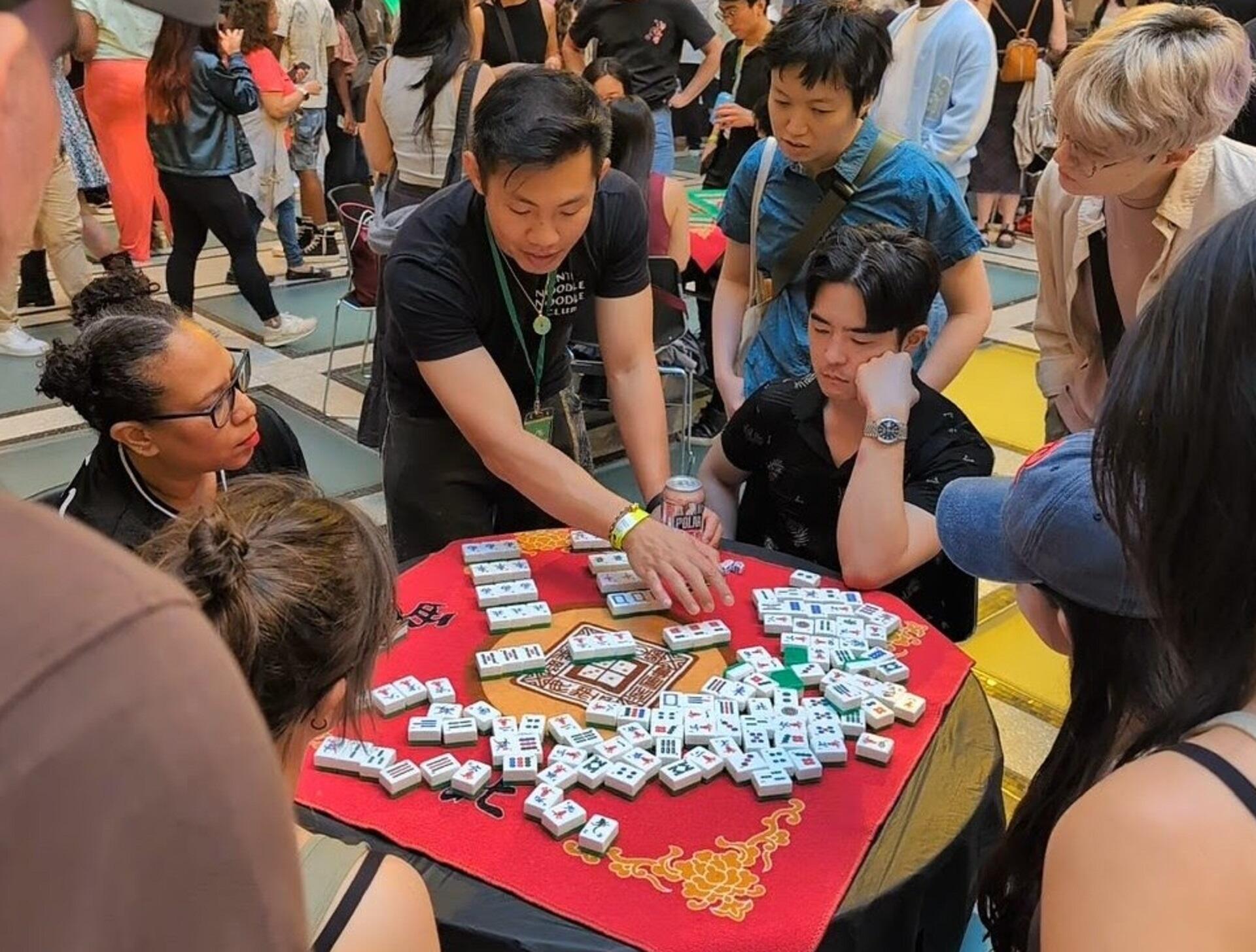
Although a typical mahjong setup features a wall in front of each player, those walls aren't theirs to draw from exclusively. Every player draws from the active wall, moving counter-clockwise to the next one once the first wall is depleted.
Across China and elsewhere in the mahjong world, automated tables shuffle the tiles and present players with ready-built walls. These tables cut down substantially on game setup time, which may take up to 10 minutes.

How Does Mahjong Work: Taking Turns
If you've ever played a card game - rummy, poker, or Go Fish- you're familiar with the draw-discard system of play. Mahjong players do the same, only with tiles3.
As the scene below from Crazy Rich Asians shows, tile draws don't always come from the walls. If another player has discarded a tile you need, you may pounce on it. However, the rule for drawing discarded tiles is clear in Chinese mahjong: you must display it in a set immediately. Other rulebooks may restrict or deny players access to discarded tiles.
Sets in Mahjong
Earlier, you read about chows, pungs, and kongs; the internationally accepted names of sets in mahjong. They are prevalent in English-language game instructions, as well as international competition. They describe components of winning hands in mahjong.
Chows
- the easiest sets to build
- sequences of 3 numbered tiles
Pung
- three of the same tile
- also called triplets
Kong
- four of the same tile
- also called quads
While these terms are quite common in American, British, and Australian mahjong, other languages use different words to describe these sets. In Mandarin, they are 'eat' (吃 - chī), 'touch' (碰 (pèng), and 'bar' (杠 - gàng), respectively.

How to Play Mahjong to Win
No matter which style of mahjong you aim to play, your goal is likely winning as many rounds as possible to achieve the highest score and, thus, win the game. Note that socialising is also an integral part of the game but, as the tiles form into walls, all that camaraderie turns into fierce competition. Everyone strives towards the ideal tile structure that may lead to the winning hand:
As mentioned above, players may draw one tile per turn from the active wall and assess its impact on their current hand. They must then discard a tile, typically the one of least use to their potential sets.
Depending on the style of mahjong you play, you may draw from the discard pile instead of the wall. Remember that many mahjong styles have distinct rules about using discarded tiles. Furthermore, drawing a discarded tile may give your opponents a clue about your game strategy4. They may then work to block you.
Mahjong is a game of strategy that nevertheless relies on a fair amount of luck and skill to crown its winners. The best strategy for beginners is to master the mahjong rules that apply to the type you're playing and then develop your game plan.
References
- Li, Leo. “The Different Types of Mahjong: A Beginner’s Guide to the Major Variants.” American Mahjong Guide, 30 May 2026, americanmahjongguide.com/types-of-mahjong.html. Accessed 27 Oct. 2026.
- Brown, Seth. “Complete Rules for How to Play Mahjong.” The Spruce Crafts, 21 Oct. 2024, www.thesprucecrafts.com/how-to-play-mahjong-411827. Accessed 27https://www.thesprucecrafts.com/how-to-play-mahjong-411827 Oct. 2026.
- How to Play Mahjong. Turn Flow. 2026, howtoplaymahjong.org/turn-flow. Accessed 27 Oct. 2026.
- Kraisoft Limited. “12 Essential Mahjong Strategies That Win Tournament.” Themahjong.Com, Kraisoft Limited, 22 Dec. 2025, themahjong.com/blog/mahjong-strategy. Accessed 27 Oct. 2026.
Summarise with AI:
Did you like this article? Leave a rating!

 Loading...